MT4 vs MT5 vs cTrader vs TradeLocker (2026)
MT4, MT5, cTrader, and TradeLocker compared, including automation support and prop firm coverage.
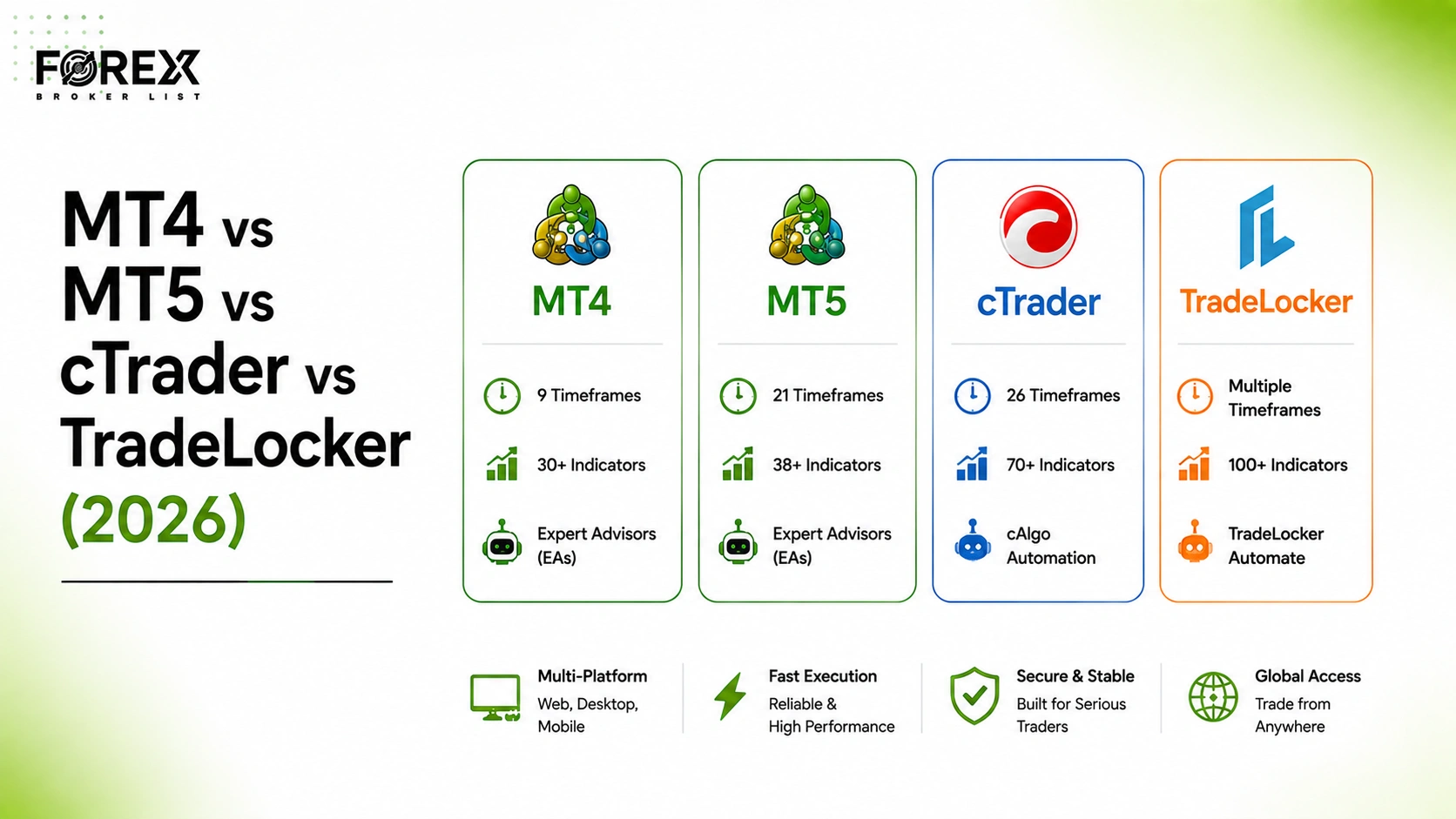
MT4 has the widest broker availability and largest EA library, but MT5 officially overtook it in trading volume in 2026. cTrader offers true ECN-style depth of market execution. TradeLocker offers the cleanest TradingView-based interface but does not natively support Expert Advisors or automated trading.
Key Takeaways
- MT5 surpassed MT4 in total trading volume in early 2026, ending nearly two decades of MT4 dominance
- MetaQuotes stopped issuing new MT4 broker licenses in 2022, so MT4 availability will keep shrinking over time
- cTrader uses genuine ECN-style depth of market execution, unlike MetaTrader's broker-quote model
- TradeLocker has no native Expert Advisor support, no bot marketplace, and no built-in backtesting as of 2026
- Prop firms increasingly support multiple platforms, but EA and automation rules differ meaningfully between them
MT4, MT5, cTrader, TradeLocker at a Glance

To easily understand the key technical features and differences among all four platforms, check out the comparison table below:
| Platform | Released | Timeframes | Scripting Language | EA/Bot Support | Execution Model |
|---|---|---|---|---|---|
| MT4 | 2005 | 9 | MQL4 | Extensive, desktop only | Broker-quote (dealing desk capable) |
| MT5 | 2010 | 21 | MQL5 | Extensive, multi-threaded | Broker-quote or ECN, broker-dependent |
| cTrader | 2011 | 28 | cAlgo (C#) | Moderate, smaller ecosystem | True ECN, full depth of market |
| TradeLocker | 2023 | Custom (TradingView-based) | None natively | Not supported natively | Broker-dependent |
This table alone explains most of the practical tradeoffs. More timeframes and a modern scripting language don't matter if your broker doesn't support the platform, and a large EA ecosystem doesn't matter if you never plan to automate anything.
MT4: Still Widely Available, But No Longer the Volume Leader
MT4 launched in 2005 and built the largest Expert Advisor ecosystem in retail forex. For almost two decades, it was the default choice simply because nearly every broker offered it.
That's changing. MetaQuotes stopped issuing new MT4 broker licenses in 2022. Existing brokers can keep running it, but no new broker can launch on MT4 today.
If you already use only established brokers offering MT4, this isn't an urgent concern. If you're evaluating a new broker or expect to switch in the next few years, don't assume MT4 will still be there.
MT5: Now the Higher-Volume Platform
MT5 launched in 2010 as MetaQuotes' intended successor to MT4, but adoption was slow for years. That changed decisively in 2026.
According to Finance Magnates Intelligence data, MT5 officially overtook MT4 in combined trading volume in Q1 2026, reaching 54.2% market share against MT4's 45.8%. This milestone had been building steadily: MT4 held 65.3% in Q4 2023, dropping to 55.8% by Q3 2024 before the final crossover.
MT5 adds real practical advantages beyond the volume shift:
- Multi-asset trading, including stocks, futures, and commodities alongside forex
- 21 timeframes versus MT4's 9
- Multi-threaded architecture that handles multiple indicators and EAs without lag
- Deeper backtesting and a more capable strategy tester
The tradeoff is real too. MQL5 is not backward compatible with MQL4, so any existing MT4 strategy needs a full rewrite to run on MT5.
cTrader: True ECN Execution and Depth of Market
cTrader launched in 2011, built from scratch rather than evolved from older software. It's most known for genuine ECN-style execution.
Where MT4 and MT5 typically use a broker-quote model, meaning the broker quotes you a price and you trade against the broker's book, cTrader connects orders into a real depth-of-market book with multiple liquidity providers. You can see exactly how this execution difference works in our ECN vs STP vs market maker guide.
cTrader's strengths are clear:
- 28 timeframes, the most of any platform compared here
- Modern, single-window interface many traders find more intuitive
- Full Level II depth of market by default
Its main limitation is ecosystem size. The cAlgo automation ecosystem and community-built tool library remain smaller than MT4 or MT5's, and cTrader broker availability is narrower too.
TradeLocker: Best Interface, No Native Automation
TradeLocker is the newest platform here, built around TradingView's charting engine. For discretionary, chart-focused traders, this is a genuine strength.
Here's the part most comparison articles gloss over: as of 2026, TradeLocker has no native MQL-equivalent scripting, no bot marketplace, and no built-in strategy tester or backtesting. "TradeLocker Studio" has been announced as a future automation feature, but it isn't available yet.
If your strategy depends on running an Expert Advisor or any automated system, TradeLocker cannot do this natively today. Some third-party trade-copier tools, like Copygram, work around this by mirroring trades from an MT4/MT5 EA onto a TradeLocker account, but that's a workaround, not native support.
Despite this, TradeLocker is gaining real traction. Prop firm Top Tier Trader dropped MetaTrader entirely in 2026, migrating its full client base to TradeLocker.
EA and Automation Support Across All 4 Platforms
This table matters more than most others in this comparison, since automation support varies sharply and isn't always what a platform's reputation suggests.
| Platform | Native EA/Bot Support | Real-World Example |
|---|---|---|
| MT4 | Yes, extensive, desktop only | Largest EA marketplace of any platform |
| MT5 | Yes, extensive, multi-threaded | Alpha Capital allows EAs on MT5, but not on cTrader, DX Trade, or TradeLocker |
| cTrader | Yes, via cAlgo, smaller ecosystem | Upcomers enabled EA support on cTrader alongside MT5, TradeLocker, Match-Trader, and Bybit in May 2026 |
| TradeLocker | No native support | Copygram and similar tools bridge MT4/MT5 EAs onto TradeLocker accounts as a workaround |
Two things stand out here. First, prop firms are actively expanding automation support beyond MetaTrader, not retreating from it. Second, "the platform supports EAs" and "this specific firm allows EAs on this platform" are two different questions, and the second one is the one that actually matters before you deploy a strategy.
Which Platform Do Prop Firms Actually Support?
Coverage varies by firm, but a consistent pattern has emerged across 2026 prop trading:
- MT5 has close to universal prop firm support and is treated as the safe default for automated strategies
- cTrader is common among firms targeting scalpers and professional-style traders, with automation increasingly permitted
- TradeLocker adoption is growing fast, particularly among newer prop firms, but always confirm EA policy per firm rather than assuming
- MT4 remains supported at many firms today, but its long-term position is weakening as new broker licenses stop issuing
If you trade across multiple prop firms, you'll likely end up needing more than one platform rather than standardizing on a single one.
Which Platform Fits Your Trading Style?
- Running existing MQL4 EAs and want the widest broker choice today: MT4, while it's still broadly available
- Want automation, multi-asset access, and the platform with rising momentum: MT5
- Prioritize tight execution transparency and don't need a large EA library: cTrader
- Value charting quality and a clean interface, and trade manually: TradeLocker
- Plan to switch brokers or prop firms in the next few years: Favor MT5 or cTrader over MT4, given MT4's shrinking broker pool
You can compare which brokers support each of these platforms directly in our full forex trading platform directory.
Conclusion
The MT4 versus MT5 versus cTrader versus TradeLocker decision looked different even a year ago. MT5 overtaking MT4 in trading volume in 2026 marks a real shift, not just a gradual trend, and MT4's shrinking broker pool since MetaQuotes stopped new licensing in 2022 makes that shift more consequential going forward. cTrader remains the execution-transparency choice for traders who value true ECN access over a large EA library, while TradeLocker's lack of native automation is a genuine dealbreaker for algo traders despite its strong charting and growing prop firm adoption. Whichever platform you're leaning toward, confirm both your specific broker's execution model and, if automation matters to you, that platform's actual EA support rather than assuming based on reputation alone. You can compare brokers by supported platform in our full forex platform directory.
Disclaimer: This article is for informational and educational purposes only. It does not constitute financial or investment advice. Forex and CFD trading involves significant risk of loss and is not suitable for all investors.
 Your brand here