Lowest Minimum Deposit Forex Brokers 2026: $1 $5 $10
Lowest minimum deposit forex brokers 2026: $0, $1, $5, $10 accounts compared with regulation and practical lot sizes.

Forex brokers low minimum deposit options let traders open a live account with $1 to $10. Pepperstone and OANDA list no stated minimum ($0). XM starts at $5. Exness and several others begin at $10. InstaForex accepts from $1. A low deposit threshold is only the entry point. Margin requirements, lot sizes, and regulation determine whether that small balance can support a real trade.
Traders who want to test live markets with limited capital look for forex brokers low minimum deposit requirements. A $5 or $10 deposit removes the biggest barrier for beginners, but it does not guarantee a usable trading balance. Position sizing, spreads, and the broker’s regulatory entity still control how far that money stretches. This guide compares current $0, $1, $5, and $10 minimums across major brokers, shows what each amount can actually buy in terms of lot size, and explains the trade-offs between offshore and Tier-1 regulated entities.
What Counts as a Low Minimum Deposit in 2026
A low minimum deposit means a broker accepts an initial funding amount of $10 or less to activate a live trading account. Some brokers advertise $0, meaning they set no formal floor. In practice, the payment method often imposes its own minimum (commonly $10 for cards or e-wallets).
| Deposit Level | Typical Broker Examples | Practical Trading Range | Main Limitation |
|---|---|---|---|
| $0 (no stated minimum) | Pepperstone, OANDA, BlackBull Markets | Micro lots once funded | Payment method floors still apply |
| $1 | InstaForex (cent/standard) | Cent lots only | Offshore regulation only |
| $5 | XM (Micro, Standard, Ultra Low) | 0.01 lots on majors | Entity-dependent regulation |
| $10 | Exness (Standard/Cent), several others | Micro or cent lots | Higher for professional accounts |
Data sourced from broker official sites and public disclosures. Last updated: October 2026.
$0 Minimum Deposit Brokers
Pepperstone states no minimum deposit on its Standard and Razor accounts. FCA, ASIC, and CySEC regulate its main entities. The practical floor for many card and e-wallet deposits is $10. Once funded, the minimum lot size is 0.01 (micro lot). A $10 balance supports one or two micro-lot trades with a tight stop-loss before margin pressure appears. (Source: Pepperstone account and funding pages, October 2026.)
OANDA also lists no minimum deposit or minimum balance requirement for its standard accounts. It is regulated by the CFTC/NFA in the United States, the FCA in the United Kingdom, and ASIC in Australia. Leverage is capped at local retail limits (1:50 in the US on major pairs, 1:30 in the UK/EU). (Source: OANDA help centre, October 2026.)
BlackBull Markets offers ECN Standard and ECN Prime accounts with a $0 stated minimum. Spreads start from 0.8 pips on Standard and 0.0 pips on Prime (plus commission). It is regulated by the FMA (New Zealand) and FSA (Seychelles). (Source: BlackBull Markets account types, October 2026.)
These $0 options work best for traders who already plan to deposit at least $50–$100 so they can size positions with a buffer.
$1 Minimum Deposit Brokers
InstaForex accepts deposits from $1 on its Insta.Standard and Cent accounts, depending on the payment method. The broker is regulated by the British Virgin Islands FSC (licence SIBA/L/14/1082), an offshore regulator. Cent accounts display balance in cents, so a $1 deposit equals 100 cents and allows nano-scale position sizing. Spreads on basic accounts start wider than those at Tier-1 brokers. (Source: InstaForex account types page and multiple reviews cross-checked October 2026.)
A $1 balance is usable only on a cent account. On a standard lot structure it cannot cover even a single micro-lot margin requirement under normal leverage.
$5 Minimum Deposit Brokers
XM requires $5 to open Micro, Standard, Ultra Low, and Zero accounts. The $5 minimum is offered through XM Global Limited, regulated by the FSC of Belize. XM also holds CySEC and other licences, but the lowest deposit threshold is tied to the Belize entity. Micro accounts allow 0.01 lots (1,000 units). Spreads on the Ultra Low account start from around 0.6–0.8 pips on EUR/USD with no commission. (Source: XM account types and funding pages, October 2026.)
With $5 and 1:500 leverage (non-EU), a trader can open a 0.01 lot position on EUR/USD, but a 50-pip adverse move costs roughly $5 and wipes the account. Negative balance protection applies on many entities, yet the practical buffer is zero.
$10 Minimum Deposit Brokers
Exness lists no account-type minimum for Standard and Standard Cent accounts. The practical floor is set by the payment method, commonly $10. Professional accounts (Pro, Raw Spread, Zero) start from $200 in most regions. Spreads on Standard start from 0.2 pips. Cent accounts allow trading with balance shown in cents. Exness holds FCA, CySEC, and other licences depending on the entity. (Source: Exness Help Centre, October 2026.)
Several other brokers advertise $10 minimums on standard or cent accounts. Always confirm the figure shown inside the broker’s personal area after registration, because region and payment method change the number.
Comparison Table: Low Minimum Deposit Forex Brokers (October 2026)
| Broker | Stated Min Deposit | Typical Practical Floor | Min Lot | Main Regulation | Best Use Case |
|---|---|---|---|---|---|
| Pepperstone | $0 | $10 (many methods) | 0.01 | FCA, ASIC, CySEC | Regulated micro trading |
| OANDA | $0 | Varies by method | Varies | CFTC/NFA, FCA, ASIC | US/UK beginners |
| BlackBull Markets | $0 | Varies | 0.01 | FMA, FSA | ECN-style from small balance |
| XM | $5 | $5 | 0.01 | FSC Belize (low-deposit entity) + CySEC | Micro lots on tight budget |
| Exness | No account min | $10 (common) | 0.01 / cent | FCA, CySEC (entity-dependent) | Cent or standard from $10 |
| InstaForex | $1 | $1–$10 | Cent | BVI FSC | Lowest possible entry |
Data sourced from broker official sites, help centres, and public disclosures. Last updated: October 2026.
How Much Can You Actually Trade With $5 or $10
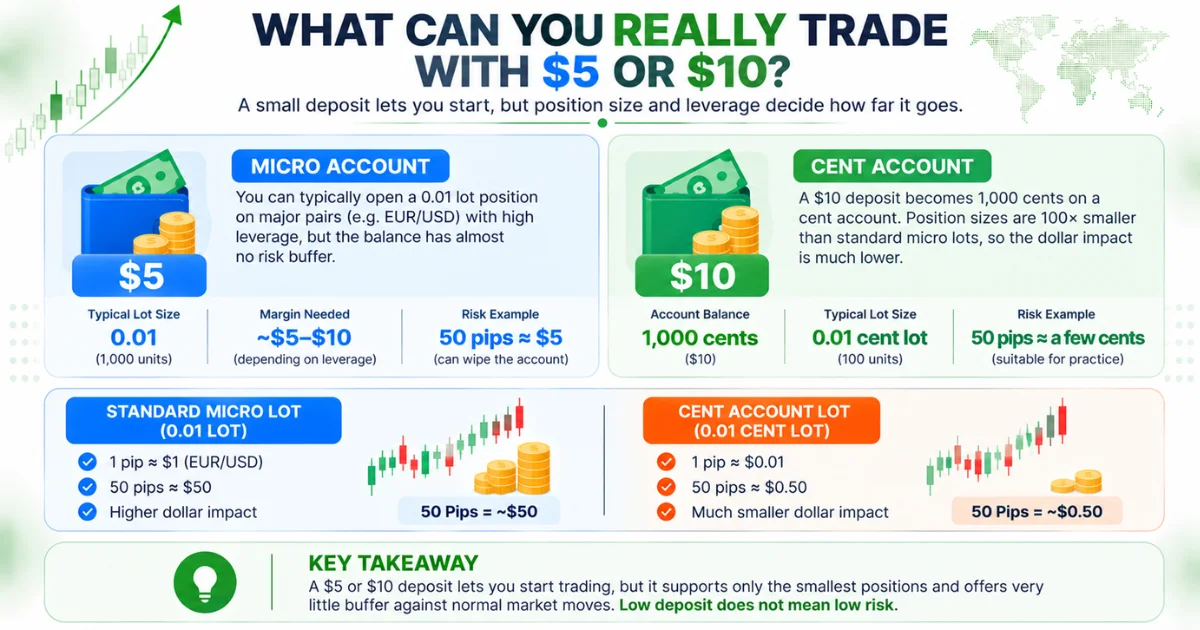
A $10 account on a standard 0.01 lot structure gives limited room. On EUR/USD with 1:100 leverage, margin for 0.01 lots is roughly $10. Any movement against the position quickly triggers a margin call or stop-out. With 1:500 leverage the margin requirement drops, but a 20-pip loss still removes a large percentage of the balance.
Cent accounts change the math. A $10 deposit becomes 1,000 cents. A 0.01 lot on a cent account is 100 times smaller than a standard micro lot. A 50-pip move costs cents instead of dollars. This setup is useful for learning order placement and emotional control. It is not useful for generating meaningful profit.
Real example: In the 2015 Swiss National Bank event, EUR/CHF dropped more than 1,800 pips in minutes. Accounts with thin buffers were wiped out or went negative before stops could execute. Brokers with negative balance protection absorbed the excess loss. Brokers without it left clients owing money. A $5 or $10 balance has no buffer against similar gaps.
Regulation and Client Protection Trade-offs
Tier-1 regulators (FCA, ASIC, CySEC, CFTC/NFA) require client money segregation, negative balance protection for retail clients, and membership in compensation schemes. Meeting these rules raises operating costs, so many Tier-1 brokers set higher recommended starting amounts even when they list a low or zero formal minimum.
Offshore regulators (BVI FSC, FSC Belize, etc.) impose lighter requirements. This allows true $1 and $5 minimums. The trade-off is weaker recourse if the broker fails or disputes a withdrawal. Always verify the exact entity and licence number on the official regulator website before depositing.
What to Check Before Depositing a Small Amount
- Confirm the minimum shown inside the broker’s client portal after KYC, not just the marketing page.
- Check the minimum lot size and whether a cent or micro account is available.
- Calculate margin for a 0.01 lot on your preferred pair at the offered leverage.
- Review the regulator’s public register for the specific entity that will hold your account.
- Test a small withdrawal before adding more funds.
Conclusion
Forex brokers low minimum deposit options in 2026 range from $0 (Pepperstone, OANDA) to $1 (InstaForex) and $5–$10 (XM, Exness). These thresholds remove the entry barrier for beginners, but a $5 or $10 balance supports only the smallest possible positions and offers almost no buffer against normal market moves. Cent accounts make the smallest deposits tradable. Tier-1 regulation provides stronger client protections than offshore licences, even when the stated minimum is higher. Deposit only what you can afford to lose, verify the licence, and treat any sub-$50 balance as an extended practice account rather than a capital-building account.
This article is for informational and educational purposes only. It does not constitute financial or investment advice. Forex and CFD trading involves significant risk of loss and is not suitable for all investors. Always verify a broker's regulatory status through official authorities such as FCA, ASIC, or CySEC before depositing funds.
 Your brand here