How to Choose the Best Forex Broker in 2026
A 5-step framework for choosing the right forex broker: regulation, execution, cost, leverage, demo testing.

The best forex broker for 2026 depends on your trading style, but the decision comes down to five checks: confirm the broker is regulated by verifying its license directly, understand its execution model, compare its real trading costs, test it on a demo account, and confirm leverage and margin terms match your risk tolerance.
Key Takeaways
- There is no single "best" forex broker, only the best fit for your trading style, deposit size, and risk tolerance
- Regulation is the non-negotiable first filter; verify the license number directly on the regulator's register before anything else
- Execution model (ECN, STP, or market maker) affects both your costs and whether your broker has a conflict of interest with your trades
- Compare total cost, not just headline spreads, since commission, swap fees, and withdrawal fees all add up
- Test any shortlisted broker on a demo account before funding a live one
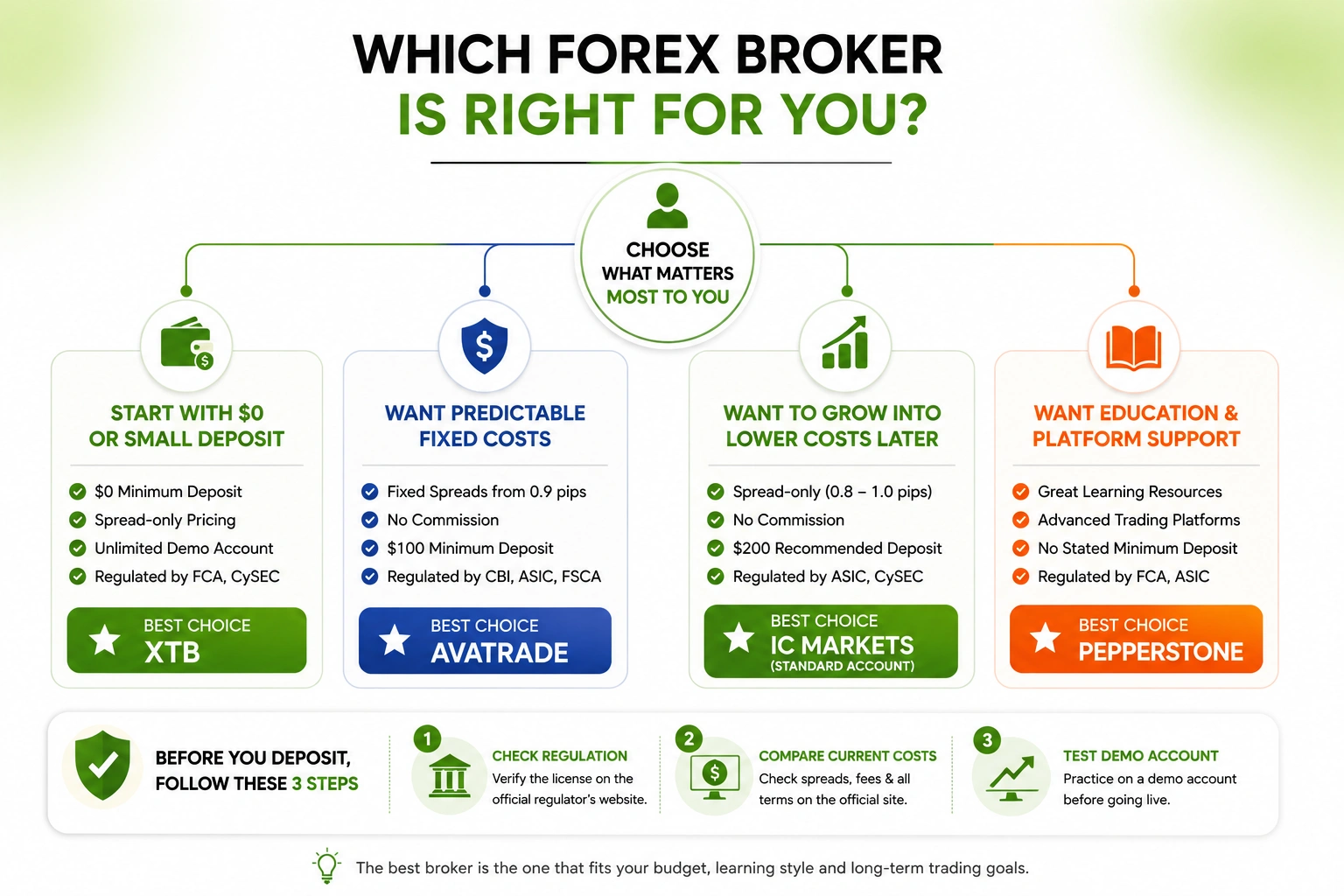
Step 1: Confirm the Broker Is Actually Regulated
This is the filter everything else depends on. A regulated broker is required to hold client funds in segregated accounts, meet minimum capital requirements, and participate in a compensation scheme if the firm fails. An unregulated one offers none of these guarantees, regardless of how professional its website looks.
Do not stop at seeing "regulated" on the homepage. Find the broker's exact legal entity name in its account terms, then search that name directly on the relevant regulator's official register, such as the FCA Financial Services Register, ASIC Professional Registers, or CySEC's public list. Brand names are sometimes shared across multiple legal entities with very different protections attached. For the full verification process and a Tier 1 vs Tier 2 vs offshore breakdown, see our complete guide on what "regulated broker" actually means.
Step 2: Understand the Broker's Execution Model
How your broker fills your orders affects both your trading costs and whether it has a structural incentive to profit from your losses. ECN brokers match your order directly against other market participants for a transparent commission. STP brokers route orders to external liquidity providers without a dealing desk, usually folding cost into the spread. Market maker brokers create an internal market and can take the opposite side of your trade, which is not automatically unsafe at a regulated firm, but is worth knowing before you commit.
Scalpers and high-frequency traders generally benefit most from ECN execution and its tighter raw spreads. Swing traders and beginners often find STP or market maker accounts simpler, since the cost is a single spread number rather than spread plus commission. The full breakdown, including a real broker comparison table, is in our guide to ECN vs STP vs market maker brokers.
Step 3: Compare Total Trading Cost, Not Just the Headline Spread
A broker advertising "spreads from 0.0 pips" can still be more expensive than one advertising 1.0 pip spreads, depending on commission structure, overnight swap rates, and any inactivity or withdrawal fees. Add up the full cost of a trade you'd realistically place, not just the number on the homepage.
| Cost Component | What to Check |
|---|---|
| Spread | Fixed or variable, and typical range during normal hours |
| Commission | Per lot, per side or round turn |
| Swap/rollover | Charged for holding positions overnight, varies daily |
| Inactivity fee | Monthly charge if account sits dormant |
| Withdrawal fee | Flat fee on certain payment methods |
You can compare live pricing and fee structures across regulated providers in our full forex broker directory.
Step 4: Match Leverage to Your Actual Risk Tolerance
Higher leverage is not automatically better. It lets you control a larger position with less capital, but it multiplies losses at the exact same rate it multiplies gains. Regulated Tier 1 brokers typically cap retail leverage at 1:30, while offshore entities of the same brands can offer 1:500 or higher.
Before choosing a broker based on its maximum leverage, work out what leverage you would actually use given your account size and risk tolerance, not the highest number the broker advertises. Our full breakdown, including a worked margin-call example and regional leverage limits, is in our guide to what leverage means in forex trading.
Step 5: Test the Broker on a Demo Account Before Going Live
Every reputable broker offers a free demo account connected to live or near-live pricing. Use it to test the actual platform, not just the marketing claims: place the order types you'll actually use, check how the charting tools feel, and confirm execution speed feels consistent with what the broker advertises.
A demo account will not replicate the psychological pressure of trading real money, so treat it as a test of the platform and your strategy's mechanics, not a full dress rehearsal for live trading. Our complete guide covers how long to demo trade and the signs you're ready to go live, with a broker demo duration comparison table, in what is a forex demo account and how to use it.
Broker Selection Checklist by Trader Type
| Trader Type | Priority Order |
|---|---|
| Complete beginner | Regulation → Demo testing → Simple cost structure (STP/market maker) → Education resources |
| Scalper / day trader | Regulation → ECN execution → Lowest raw spread + commission → Fast platform execution |
| Swing trader | Regulation → Swap rate competitiveness → Platform charting tools → STP or fixed-spread account |
| Higher-risk / high-leverage trader | Regulation (verify entity carefully) → Available leverage tier → Margin call/stop-out terms → Total cost at high volume |
Conclusion
Choosing the best forex broker in 2026 is not about finding a single universally "best" option, it is a five-step filtering process: verify regulation first, understand the execution model, compare total trading cost rather than headline numbers, match leverage to your real risk tolerance, and test everything on a demo account before committing real capital. Work through these five checks in order, and the right broker for your specific trading style becomes a much clearer decision.
Disclaimer: This article is for informational and educational purposes only. It does not constitute financial or investment advice. Forex and CFD trading involves significant risk of loss and is not suitable for all investors. Always verify a broker's regulatory status directly through official authorities such as FCA, ASIC, or CySEC before depositing funds.
 Your brand here