Forex Margin Explained: Margin, Free Margin, Call
Forex margin, free margin and margin call explained with a real worked example and actual stop-out percentages.
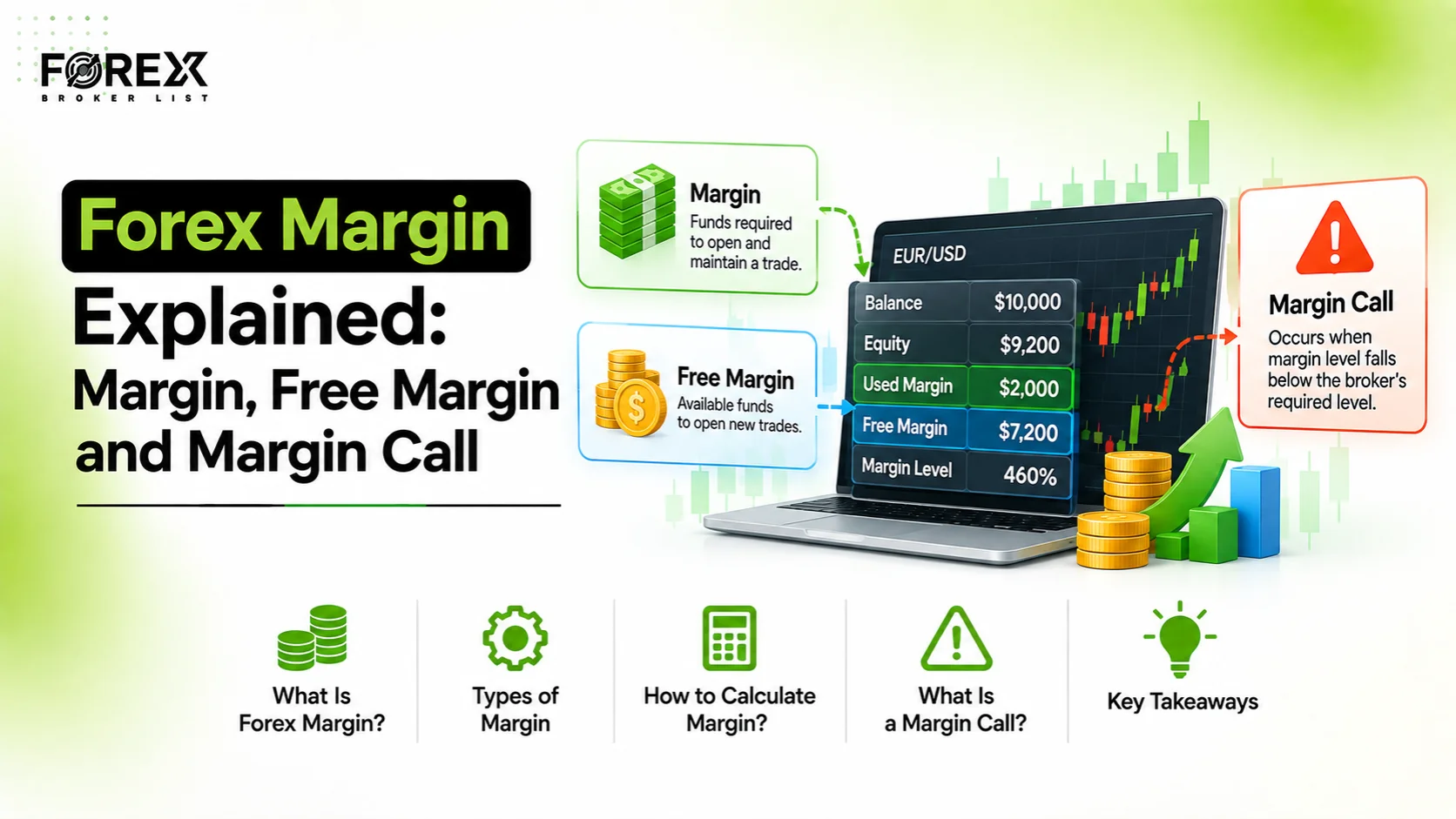
Forex margin is the deposit your broker sets aside from your account to open and hold a leveraged position. It is not a fee, it is collateral. Free margin is what remains available for new trades. A margin call is a warning that your account equity has fallen too close to that collateral requirement, and if it falls further, a stop out closes positions automatically.
Introduction
Margin is what makes a $1,000 account able to control a $33,000 position, and it is also what can end that same account in a single volatile session if you do not understand how it moves. Every leveraged forex trade sets aside part of your equity as margin, and how that number relates to your free margin and margin level determines whether your account survives a losing streak or gets closed out by the broker. Understanding how leverage works in forex is the starting point, since leverage is what sets the margin requirement in the first place.
What Is Forex Margin?
Forex margin is the amount of money your broker sets aside from your account balance as collateral to open and maintain a leveraged position. It is not a cost charged to you and not a fee deducted from your account. It is your own money, temporarily reserved.
When you open a position, your broker calculates the required margin based on the position size and your account's leverage ratio, then holds that amount separately from the rest of your available balance. You still own that money. You simply cannot use it to open additional trades while the original position remains open.
Margin exists because forex trading is leveraged. Without leverage, you would need the full value of a position in cash. Margin lets you control a much larger position with a smaller deposit, with the broker requiring only a fraction of the position's true value as security.
How Forex Margin Is Calculated
The core formula is:
Required Margin = Position Size / Leverage
Position size is the full notional value of the trade, calculated as the number of units traded multiplied by the current price. Leverage is expressed as a ratio, such as 1:30 or 1:100, set by your broker and often capped by regulation.
Example: You open 1 standard lot (100,000 units) of EUR/USD at a price of 1.1000, with leverage of 1:100.
Position value = 100,000 x 1.1000 = $110,000 Required margin = $110,000 / 100 = $1,100
That $1,100 is what your broker reserves from your account to hold this single position open. Higher leverage lowers the required margin for the same position size. Lower leverage, common under stricter regulatory regimes, raises it.
Margin vs Leverage: What's the Difference?
Margin and leverage are directly linked but describe different things, and mixing them up is a common point of confusion for new traders.
Leverage is the ratio your broker allows, expressed as something like 1:30 or 1:500. It determines how much position size you can control per dollar of margin.
Margin is the actual dollar amount reserved from your account for a specific position, calculated using that leverage ratio.
Think of leverage as the rule and margin as the result of applying that rule to a specific trade. A 1:100 leverage ratio does not cost you anything by itself. It only becomes a real dollar figure, the required margin, once you actually open a position of a given size at that leverage.
Higher leverage means a lower margin requirement for the same position size, which is why high-leverage accounts let a small deposit control a large position. It also means the same price movement represents a larger percentage swing relative to your margin, which is the actual source of higher risk, not the leverage number itself.
Used Margin, Free Margin and Equity Explained
Three linked figures appear on every trading platform, and understanding how they connect to each other matters before opening a leveraged position.
Equity is your account balance adjusted for the floating profit or loss of any open positions. It updates in real time as prices move.
Used margin is the total amount currently reserved across all your open positions, calculated using the required margin formula above and summed if you hold more than one trade.
Free margin is what remains available to open new positions, calculated as:
Free Margin = Equity - Used Margin
If your equity is $1,000 and your used margin across open positions is $330, your free margin is $670. That $670 is what you actually have available to open additional trades or absorb further floating losses before your account runs into trouble.
Worked Example: Tracking Margin Through a Live Trade
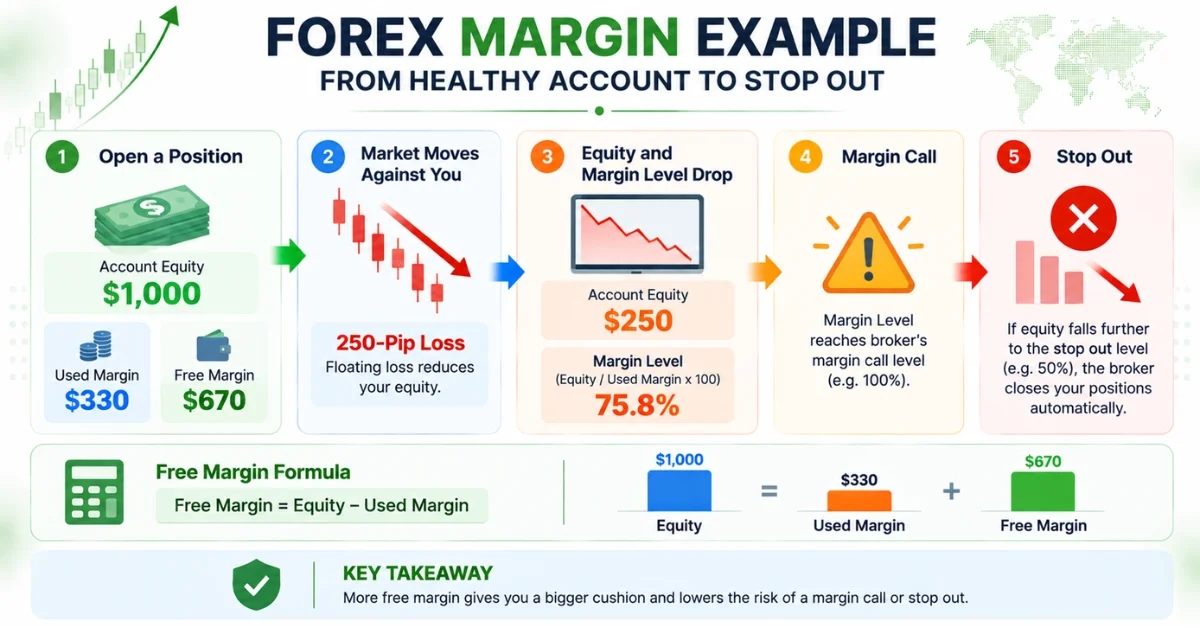
Following one account through a full sequence makes the relationship between these figures concrete.
Starting position: Account equity: $1,000 Trade: Buy 3 mini lots (30,000 units) of EUR/USD at 1.1000 Leverage: 1:100
Position value = 30,000 x 1.1000 = $33,000 Used margin = $33,000 / 100 = $330 Free margin = $1,000 - $330 = $670 Margin level = ($1,000 / $330) x 100 = 303%
After an adverse move: EUR/USD falls 250 pips against the position. Loss = 30,000 x 0.0250 = $750.
New equity = $1,000 - $750 = $250 Used margin remains approximately $330 New margin level = ($250 / $330) x 100 = 75.8%
At this point the account has crossed below a typical 90% margin call threshold, covered in detail below.
A further move toward stop out: An additional 28 pips of adverse movement brings equity down to roughly $165, dropping margin level to approximately 50%, the typical stop-out threshold at which a broker begins automatically closing positions. The distance between the margin call warning and the actual stop out was under 30 pips in this example, which is why margin level should be monitored continuously rather than checked occasionally.
What Is Margin Level in Forex?
Margin level is the single number your platform uses to judge how much breathing room your account has, expressed as a percentage.
Margin Level = (Equity / Used Margin) x 100
A margin level of 300% or higher generally indicates a healthy account with substantial free margin relative to open positions. As margin level falls toward 100%, free margin approaches zero. Below that, most brokers issue a margin call warning at a set threshold, and further declines trigger an automatic stop out.
Margin level moves in real time with every price tick affecting your open positions, which is why it can change faster than a trader expects, particularly on leveraged, volatile pairs.
What Is a Forex Margin Call?
A forex margin call is a warning triggered when your account's margin level falls below a set threshold, most commonly around 90% on MT4/MT5 platforms at major brokers. It signals that your equity is approaching the point where you no longer have sufficient free margin to safely hold your current positions.
A margin call is not, by itself, an automatic closure of your trades. It is a warning stage. Depending on your broker and platform, you may receive a notification, an email, or simply see the margin level indicator turn red on your platform. What you do next, adding funds, closing part of the position, or doing nothing, determines what happens as the market continues to move.
Margin Call vs Stop Out: Real Numbers
These thresholds are set by the broker and the trading platform, not by any universal industry standard, and they vary meaningfully across brokers and even across platforms from the same broker.
| Platform | Margin Call Warning | Stop Out Level (Retail) | Stop Out Level (Professional) |
|---|---|---|---|
| MT4 / MT5 | Below 90% margin level | Below 50% margin level | Below 20% margin level |
| cTrader | Configurable tiers, default 150% / 100% / 80% | Below 50% (Smart Stop Out) | Below 50% (Smart Stop Out) |
Data sourced from Pepperstone's published margin call and stop out disclosure, 2026. Thresholds are broker-set and platform-set, not universal constants. Always confirm your own broker's exact margin call and stop out levels in your account documentation. For a deeper breakdown of how leverage interacts with these thresholds, see our leverage risk guide.
Note the platform difference even within a single broker. cTrader's "Smart Stop Out" closes only enough of a position to bring margin level back above the threshold, rather than closing the entire trade at once, which is a materially different mechanic from a full liquidation on MT4/MT5.
What Happens After a Margin Call
If margin level continues falling past the margin call warning, the broker's stop-out logic activates automatically, closing positions, usually starting with the largest losing trade, until margin level rises back above the stop-out threshold or no positions remain open.
This process happens without further input from the trader. You do not need to approve it, and in fast-moving markets it can execute within seconds of the threshold being crossed. Most regulated retail brokers also apply negative balance protection, meaning your account cannot be forced below zero even if the market gaps sharply past your stop-out point, though this protection is jurisdiction-dependent and not universal across every offshore broker.
A scenario that catches traders off guard is holding several correlated positions at once, for example multiple EUR pairs moving together during a single news event. Each position individually looks manageable, but because they move in the same direction simultaneously, combined floating losses erode margin level far faster than a trader tracking each trade separately would expect. Margin level reflects your whole account, not each position in isolation, which is easy to overlook until a correlated move forces the point.
How to Avoid a Margin Call in Forex
Several practical habits keep margin level in a safer range.
- Use smaller position sizes relative to your account balance. A lower used-margin figure means more room before margin level drops into warning territory.
- Set stop-loss orders on every position. A stop loss caps your maximum loss before margin level ever approaches the call threshold, rather than relying on the broker's stop-out mechanism as your risk management.
- Monitor margin level actively, not just account balance. Balance alone does not show how close you are to a call, since it ignores floating losses on open positions.
- Avoid over-leveraging on correlated pairs. Multiple positions in the same currency direction behave as one larger position for margin purposes during a correlated move.
- Choose appropriate leverage for your experience level. Higher leverage is not free performance. It compresses the price movement needed to reach a margin call, so match your leverage choice to your actual risk tolerance rather than the maximum your broker allows.
Comparing 750+ broker listings on margin call thresholds and available leverage tiers is a reasonable step before opening an account, since these terms genuinely differ and affect how much room your account has under pressure.
Forex Margin Requirements by Broker Type
Available leverage, and therefore required margin, varies significantly depending on where and how a broker is regulated.
Under ESMA rules applying across the EU, retail leverage on major currency pairs is capped at 30:1, with lower caps of 20:1 on non-major pairs and gold, 10:1 on other commodities, 5:1 on individual equities, and 2:1 on cryptocurrencies (Source: European Securities and Markets Authority, retail leverage limits). The UK's FCA and Australia's ASIC apply comparable 30:1 retail caps on major pairs.
Offshore-regulated entities, common among brokers licensed in jurisdictions such as Vanuatu, Seychelles, or Mauritius, frequently offer leverage of 500:1 or higher with no equivalent regulatory cap. Higher leverage lowers the required margin for a given position size, which can make an account appear to have more breathing room while actually carrying substantially more risk per dollar of movement.
Neither structure is automatically better. A tightly capped, regulated entity trades lower leverage for stronger investor protections. An offshore entity trades higher leverage for materially thinner regulatory oversight. Match the choice to how much protection you value against how much leverage your strategy actually needs.
Conclusion
Forex margin is not a cost, it is the mechanism that makes leveraged trading possible, and understanding how margin, free margin, and margin level connect turns an abstract platform number into something you can actively manage. Margin call and stop-out thresholds are broker-set and platform-set, not universal, so know your own broker's exact levels rather than assuming a generic rule. Position sizing, stop losses, and matching leverage to your actual risk tolerance keep margin level in a range where you are making trading decisions, not your broker's stop-out logic.
Risk Disclaimer: This article is for informational and educational purposes only. It does not constitute financial or investment advice. Forex and CFD trading involves significant risk of loss and is not suitable for all investors. Always verify a broker's regulatory status through official authorities such as FCA, ASIC, or CySEC before depositing funds.
Frequently Asked Questions
1. What is margin in forex trading?
Margin is the portion of your account balance that your broker reserves as collateral to open and hold a leveraged position. It is calculated as position size divided by leverage, and it remains your money, simply set aside while the position is open.
2. What is free margin in forex?
Free margin is the amount of your equity not currently tied up as collateral for open positions. It equals your equity minus your used margin, and it represents what you have available to open new trades or absorb further floating losses.
3. What is used margin in forex?
Used margin is the total amount currently reserved across all of your open positions. If you hold multiple trades, used margin is the sum of the required margin for each one.
4. What is margin level in forex?
Margin level is your equity divided by your used margin, expressed as a percentage. It is the single figure brokers use to determine when to issue a margin call warning and when to trigger an automatic stop out.
5. What causes a margin call in forex?
A margin call is triggered when floating losses on open positions reduce your account equity enough that margin level falls below a set threshold, commonly around 90% on major MT4/MT5 platforms.
6. What happens when forex margin reaches zero?
Margin level approaching zero means equity has fallen close to or below the used margin requirement. Well before this point, the broker's stop-out mechanism activates automatically, closing positions to prevent the account from being pushed into a negative balance.
7. What is stop out in forex trading?
Stop out is the automatic closure of open positions once margin level falls below a broker-set threshold, commonly 50% on MT4/MT5 for retail clients. It happens without trader input, closing positions, usually starting with the largest loss, until margin level recovers above the threshold.
8. Difference between margin and leverage in forex?
Leverage is the ratio set by your broker, such as 1:100, that determines how large a position you can control per dollar of margin. Margin is the actual dollar amount reserved for a specific trade, calculated by applying that leverage ratio to the position size.
9. Difference between free margin and used margin?
Used margin is the amount currently reserved as collateral for your open positions. Free margin is what remains from your equity after subtracting used margin, available for new trades or to absorb further losses.
10. How is forex margin calculated?
Required margin equals position size divided by leverage. Position size is the number of units traded multiplied by the current price. A 1 standard lot EUR/USD position at 1.1000 with 1:100 leverage requires $1,100 in margin.
 Your brand here