Forex Broker Technology Stack: Complete Guide
Forex broker technology stack explained: 6 layers, real costs, and white label vs build-in-house.
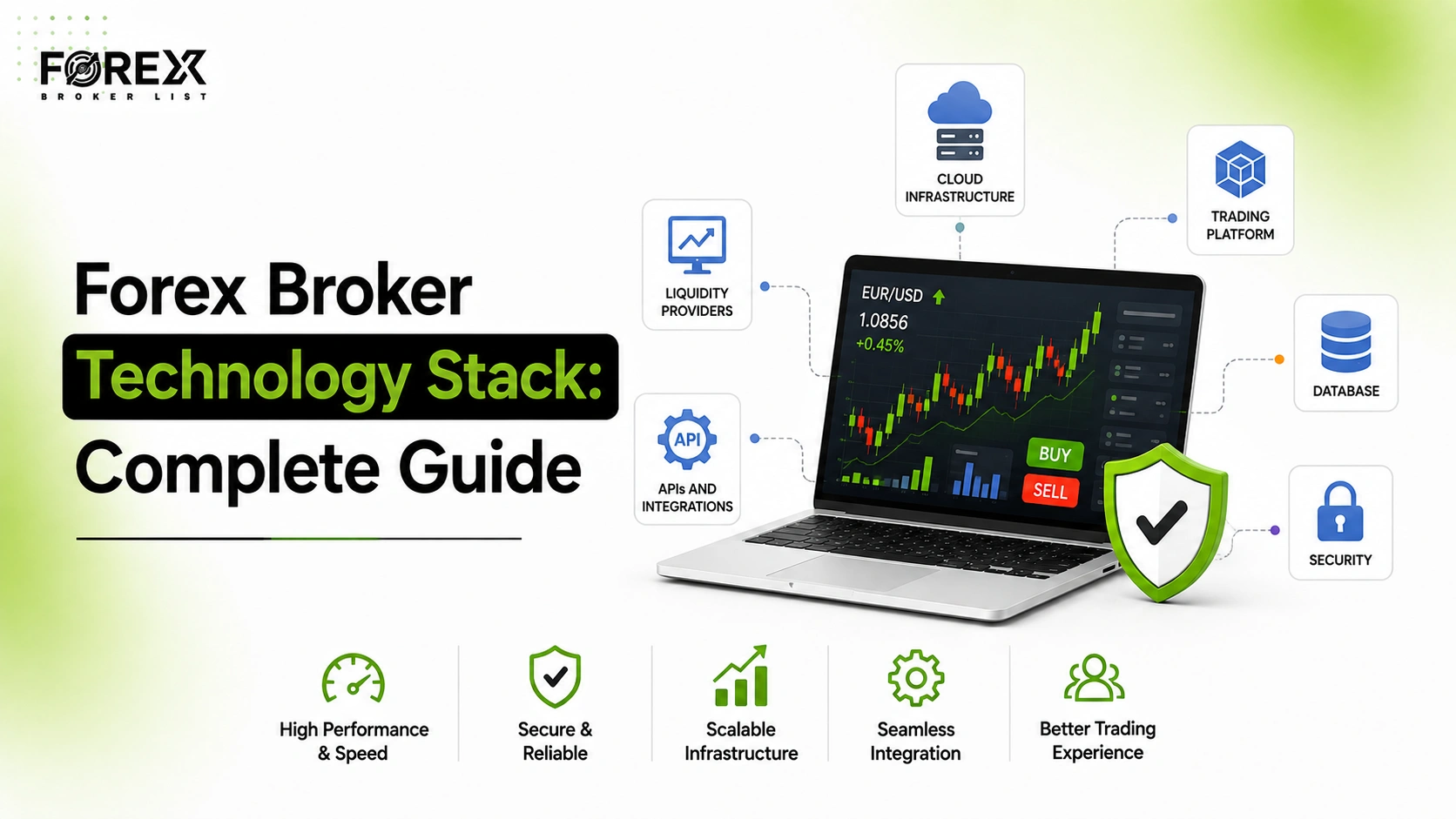
A forex broker technology stack has five to six core layers: the trading platform, liquidity and connectivity infrastructure, CRM and back office, payment processing, compliance and KYC/AML tooling, and often a separate client-facing applications layer. First-year costs range from roughly $80,000 for a lean white label setup to $400,000 or more for a fully custom-built infrastructure.
Key Takeaways
- Every layer of a broker's technology stack connects to the others; a weak link in one layer creates friction across the entire operation
- Liquidity, bridge, payment, and platform layers are the most commonly outsourced through specialist providers rather than built in-house
- Reported first-year cost estimates range from $80,000 to over $1,000,000, and the gap comes down to build-vs-buy choices, not inconsistent pricing
- White label and turnkey solutions remain the fastest path to launch for most new brokerages in 2026
- Understanding this stack helps traders too, since it explains why execution quality, deposit speed, and platform reliability differ so much between brokers
The 6 Layers of a Forex Broker Technology Stack

A fully operational forex brokerage runs on six interconnected layers. Each layer handles a distinct function, but none of them work in isolation.
- Trading platform, the client-facing execution interface
- Liquidity and connectivity infrastructure, the source of tradable pricing
- Bridge technology, the middleware connecting platform to liquidity
- Payment processing, handling deposits and withdrawals
- Compliance and KYC/AML tooling, the regulatory backbone
- CRM and back office, the operational hub everything else reports into
This guide walks through each layer, what it actually costs, and how brokers decide between building it themselves or buying it from a specialist provider.
Layer 1: Trading Platform
The trading platform is the most visible part of the stack, since it's what clients interact with every day. Its reliability, execution speed, and feature set directly shape client satisfaction and retention.
Most brokers license MT4, MT5, cTrader, or a newer platform like TradeLocker rather than building their own from scratch. Each comes with meaningfully different tradeoffs in automation support, execution model, and broker availability.
For a full breakdown of how these platforms differ, including which ones actually support Expert Advisors and automated trading in 2026, see our guide comparing MT4, MT5, cTrader, and TradeLocker.
Layer 2: Liquidity and Connectivity Infrastructure
Liquidity determines execution quality more than almost any other single factor in the stack. Most retail brokers cannot access Tier 1 banks directly and instead work through a Prime of Prime provider that aggregates institutional liquidity.
Minimum capital requirements for a direct Prime of Prime relationship commonly range from $500,000 to $2,000,000, which is why most brokers, particularly newer ones, rely on aggregated PoP access rather than direct bank relationships.
Our full guide explains what a liquidity provider actually is, including the Tier 1 vs Tier 2 distinction and how brokers evaluate provider quality.
Layer 3: The Bridge Connecting Platform to Liquidity
The bridge is the middleware layer that connects the trading platform to liquidity providers. Without it, platforms like MT4 and MT5 cannot communicate with liquidity providers at all, since they don't natively support the FIX API protocol institutional liquidity runs on.
Bridge setup typically involves a one-time connection fee, commonly around $5,000, plus ongoing monthly infrastructure costs layered on top of the core platform license.
Our complete breakdown covers what a forex bridge does and the specific signs that indicate a bridge is underperforming.
Layer 4: Payment Processing (PSP)
Payment infrastructure is where forex brokers face a distinct challenge most other industries don't: forex is classified as high-risk by most mainstream payment processors, narrowing which providers will work with a brokerage at all.
Most brokers rely on a specialized forex PSP rather than a standard payment gateway, since a PSP bundles the gateway, merchant account, processing, and fraud tooling into one integrated relationship.
Our guide on PSP vs traditional payment gateway covers how to select a forex PSP and why rolling reserves are standard practice rather than a warning sign.
Layer 5: Automation and Algo Trading Tools
This layer isn't always listed as core infrastructure, but it increasingly shapes competitive differentiation. Brokers now commonly support Expert Advisors, no-code bot builders, and copy trading functionality as client-facing features rather than afterthoughts.
Platform choice directly constrains this layer. Not every platform supports the same automation depth, and getting this wrong at the infrastructure level limits what a broker can later offer clients.
Our guide breaks down EAs, bots, and copy trading for anyone evaluating this layer from either the broker or trader side.
Layer 6: CRM, Back Office, and Compliance
The CRM functions as the operational hub every other layer reports into. Account balances, KYC status, IB commission tracking, and support tickets all typically flow through this single system.
Compliance and KYC/AML tooling sits alongside it, handling identity verification, sanctions screening, and the regulatory reporting that licensed brokers are legally required to maintain.
Weak integration between the CRM and every other layer is one of the most common operational bottlenecks brokers report, since manual reconciliation between disconnected systems creates errors and delays at scale.
What This Actually Costs (Reconciling the Numbers)
Reported first-year cost estimates vary widely across industry sources, and the gap can look confusing without context.
| Source | Estimate | What It Covers |
|---|---|---|
| Zitadelle AG | $30,000-$80,000/year | Full MT5 + liquidity + CRM + payments, ongoing fees only |
| DivulgeTech | $80,000-$400,000 first year | Full six-layer stack, make-vs-buy variable |
| B2Broker | $15,000-$50,000 setup, $25,000-$50,000+/month | White label/turnkey package plus ongoing operational costs |
| Brokeret | $100,000-$1,000,000+ | Total launch cost including licensing, technology, and liquidity funding |
The variance comes down to three decisions: whether you build components in-house or license them, which jurisdiction and license tier you're operating under, and whether liquidity is accessed through a lean aggregator or a direct Prime of Prime relationship requiring $500,000+ in margin funding.
White Label vs Building In-House: Which Fits Your Stage?
- Pre-launch or early-stage brokerage: A white label or turnkey solution is almost always the faster, cheaper path, bundling platform, CRM, and often bridge and PSP connections into one deployment
- Scaling brokerage with growing volume: This is typically when brokers start negotiating direct liquidity relationships and building custom CRM integrations, moving pieces of the stack off the white label package selectively
- Established brokerage with significant volume: Direct Prime of Prime relationships, in-house risk management systems, and custom platform integrations become cost-effective at this scale, where the white label markup outweighs the convenience
Most brokers don't make this an all-or-nothing decision. A common pattern is licensing the trading platform while building custom CRM and compliance tooling, or using a white label PSP relationship while negotiating direct liquidity separately.
Conclusion
A forex broker's technology stack is not a single purchasing decision but a set of interconnected layers, from the trading platform clients interact with daily down to the CRM and compliance tooling running quietly in the background. Reported cost estimates vary widely mainly because build-vs-buy decisions and liquidity access structure drive most of the difference, not inconsistent industry pricing. For traders, understanding this stack explains something practical: why execution quality, deposit speed, and available automation tools differ so much between brokers that look similar on the surface. You can explore the individual pieces of this stack, including liquidity providers, bridge technology, PSP partners, and trading platforms, across our full forex broker directory.
Disclaimer: This article is for informational and educational purposes only. It does not constitute financial or investment advice. Forex and CFD trading involves significant risk of loss and is not suitable for all investors.
 Your brand here