Best Liquidity Providers for Forex Brokers (2026 Comparison)
2026 comparison of forex broker liquidity providers including LMAX, Finalto and Match-Prime with regulation and spreads.

Best liquidity providers for forex brokers in 2026 are primarily prime-of-prime (PoP) firms and multi-asset aggregators such as LMAX Global, Finalto, Match-Prime, and B2Broker. These providers supply the bid/ask prices and depth that retail and institutional brokers pass through to clients via STP or ECN models. Choosing the right one directly affects spreads, rejection rates, and execution quality during volatile sessions.
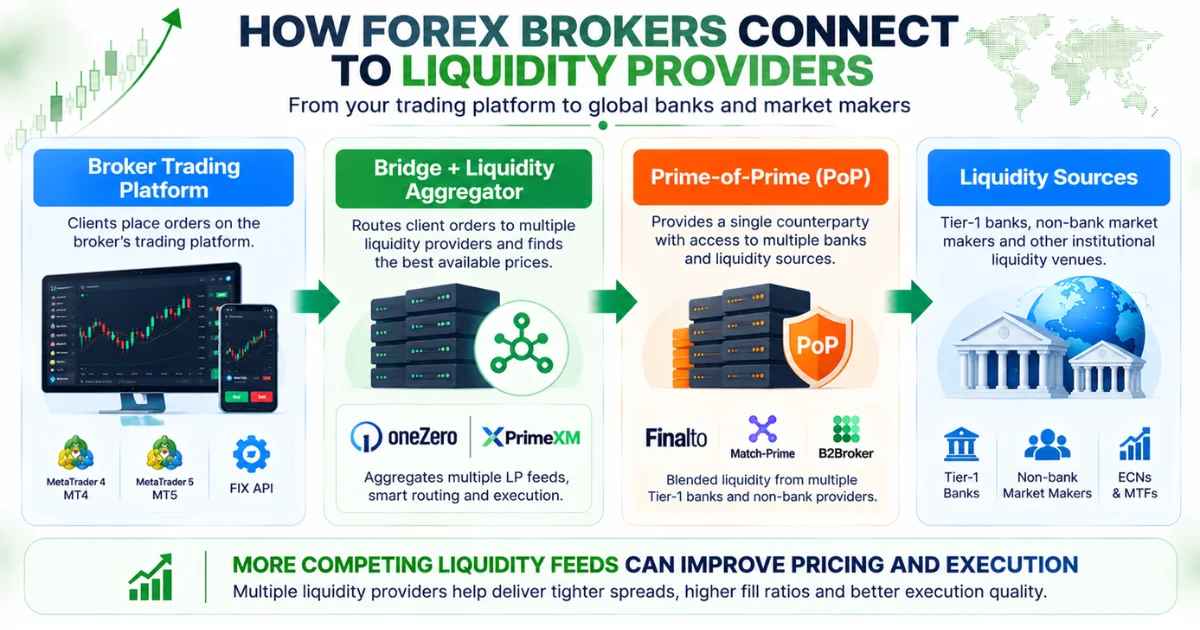
Brokers do not source liquidity from Tier-1 banks directly in most cases. They contract with a PoP or aggregator that intermediates credit and blends bank and non-bank feeds. The difference shows up in fill ratios, last-look policies, and how pricing holds during news events. A broker running an A-book model needs reliable external hedges; a hybrid setup needs flexible routing rules. This comparison covers the practical differences that matter when you review an LP agreement or test live flow.
What a Liquidity Provider Does for a Forex Broker
A liquidity provider (LP) supplies the continuous two-way prices that a broker’s clients trade against. In an STP or ECN setup the broker routes client orders to one or more LPs and earns a markup or commission. The LP’s depth, latency, and rejection policy determine the spreads clients actually see and the slippage they experience on market orders.
Most retail brokers never connect straight to a Tier-1 bank. Capital and credit requirements are too high. Instead they use a prime-of-prime firm that aggregates multiple banks and non-bank market makers, then offers the broker a single counterparty relationship. Aggregators such as oneZero or PrimeXM sit in the middle: they do not always act as the counterparty themselves but route and manage the streams. The result for the end client is tighter raw spreads on majors when multiple LPs compete, or wider spreads and higher rejections when only one weak feed is active.
Internal links: What Is a Liquidity Provider in Forex and What Is a Forex Bridge and Why Brokers Need One.
How Brokers Access Liquidity: PoP, Aggregators, and Bridges
Three common routes exist:
- Direct or near-direct PoP contract: the broker signs with a regulated PoP that provides a blended feed and takes the credit risk.
- Aggregator + multiple LPs: technology such as oneZero Hub or PrimeXM XCore pulls quotes from 100+ sources and applies smart routing.
- Bridge technology: MT4/MT5 or FIX bridges (oneZero, PrimeXM, Gold-i, etc.) connect the broker’s platform servers to the LP feeds.
oneZero reports its technology processes more than $250 billion average daily volume, 14 million transactions, and 400 billion quotes per day (Source: oneZero official site, October 2026). That scale explains why many mid-size brokers route through its Hub rather than building their own aggregation. The bridge itself does not create liquidity; it only distributes whatever the connected LPs supply.
Key Factors When Comparing Liquidity Providers
Compare these points before signing:
- Regulation of the entity you will contract with (FCA, CySEC, ASIC, etc.).
- Last-look policy: firm liquidity (no last look) versus last-look rejection.
- Instrument coverage and market depth on majors, gold, and indices.
- Latency and data-centre locations (LD4, NY4, TY3, SG1 common).
- Minimum volume or equity requirements and credit terms.
- Transparency of execution data (fill ratios, average spreads during stress).
- Integration cost and support for MT4, MT5, cTrader, or FIX API.
A 2015 Swiss National Bank event and the 2020 oil price collapse both showed that weak LP feeds can produce cascading rejections and wide spreads. Brokers that published real-time depth or used multiple PoPs recovered faster.
Top Liquidity Providers Compared (2026)
| Provider | Type | Regulation (examples) | Instruments (approx.) | Notable Feature | Best Suited For |
|---|---|---|---|---|---|
| LMAX Global | Exchange / MTF + PoP | FCA, CySEC, MAS | FX, metals, indices, crypto | Firm limit orders, no last-look | Institutional and algo flow |
| Finalto | Prime of Prime | FCA (481853), CySEC, ASIC | 3,000+ multi-asset | Tier-1 bank connectivity + risk tools | Established multi-asset brokers |
| Match-Prime | Prime of Prime | CySEC (390/20) | 2,000+ | Published stress-event spreads | Growing brokers wanting transparency |
| B2Broker | Prime of Prime + tech | Multi-jurisdictional | 1,500+ | Full white-label stack | New and hybrid brokers |
| Advanced Markets | Prime of Prime | FCA, ASIC | Multi-asset | DMA execution | Hedge-fund style flow |
| oneZero | Aggregator / Bridge | N/A (tech provider) | Access via connected LPs | $250B+ ADV technology | Brokers needing aggregation scale |
Data sourced from provider official sites, CySEC and FCA registers, and Finance Magnates coverage. Last updated: October 2026.
LMAX Global operates an FCA-regulated multilateral trading facility and offers firm liquidity with no last-look rejections on limit orders. Finalto Financial Services Limited holds FCA authorisation (licence 481853) and lists direct Tier-1 bank relationships plus 3,000+ instruments. Match-Prime (MTG Liquidity Ltd, CySEC licence 390/20) published average XAUUSD spreads of 12.5 cents on the 2 October 2026 NFP release versus wider averages from peer PoPs in the same window (Source: Match-Prime execution data release, October 2026).
LMAX Global: Firm Liquidity Model
LMAX Global gives brokers access to its exchange-style central limit order book plus additional peer pools. The firm-liquidity model means limit orders are not subject to last-look rejection. Execution is price-time priority. Brokers connect via FIX or through certified bridges (oneZero, PrimeXM, MetaQuotes). Data centres include LD4, NY4, TY3 and SG1. This setup suits high-frequency or professional flow that prioritises certainty of fill over the absolute tightest headline spread.
Finalto and Match-Prime: PoP Options with Regulatory Coverage
Finalto aggregates Tier-1 bank and non-bank feeds and offers real-time risk tools and multi-asset margin. Its UK entity is authorised by the FCA; other entities hold CySEC, ASIC and additional licences. Match-Prime positions itself as a pure PoP with in-house technology from Match-Trade. It reports 2,000+ instruments and has begun publishing average spreads from named stress days. Both are available only to professional clients and eligible counterparties under their respective licences.
Internal link: ECN Forex Brokers for end-client comparison of brokers that use these or similar LPs.
oneZero and PrimeXM: Aggregation Technology
oneZero and PrimeXM are primarily technology providers. oneZero’s Hub aggregates feeds from 200+ brokers and LPs and processes the volumes noted above. PrimeXM’s XCore pulls from more than 120 sources and supports MT4, MT5 and FIX. Brokers still need underlying LP contracts; the aggregator only optimises routing and adds resilience when one feed widens. Many mid-size brokers combine oneZero or PrimeXM with two or three PoPs rather than relying on a single source.
How LP Choice Affects Client Spreads and Execution
A broker using multiple competing LPs through an aggregator typically shows raw EUR/USD spreads starting from 0.0–0.1 pips during liquid London hours, plus a commission (example: IC Markets Raw account historically near 0.0–0.1 pips + $7 round-turn, Source: IC Markets site data as of earlier 2026). A single weak LP produces wider average spreads and higher rejection rates, especially around NFP or central-bank decisions. Clients on pure market-maker accounts do not see the external LP feed at all; the broker internalises the flow.
Related reading: Best ECN Brokers With Lowest Spreads and Forex Brokers With Highest Leverage.
Practical Checklist Before Signing an LP Agreement
- Verify the exact legal entity and licence number on the official regulator register (FCA Financial Services Register, CySEC, ASIC).
- Request recent fill-ratio and average-spread data for your target instruments, including at least one news event.
- Confirm last-look policy in writing and test it with small live flow.
- Check data-centre latency from your server location and ask about failover.
- Review minimum volume commitments, termination clauses, and credit limits.
- Test integration on a staging MT4/MT5 or FIX environment before go-live.
Brokers that skip live testing often discover rejection spikes only after client volume arrives.
Conclusion
The best liquidity providers for forex brokers in 2026 are those that combine regulated PoP status, measurable execution quality, and practical integration with existing bridges. LMAX Global stands out for firm, no-last-look liquidity. Finalto and Match-Prime offer regulated multi-asset feeds with published performance data. Aggregators such as oneZero supply the scale and routing that most retail brokers need. Always confirm the contracting entity on the regulator’s register and run live tests before committing client flow. Spreads and fill rates on the client side are the final proof.
This article is for informational and educational purposes only. It does not constitute financial or investment advice. Forex and CFD trading involves significant risk of loss and is not suitable for all investors. Always verify a broker's regulatory status through official authorities such as FCA, ASIC, or CySEC before depositing funds.
 Your brand here