Best Forex Brokers for Beginners in 2026 (Verified)
Beginner forex brokers compared on deposit, demo access, and pricing, with verified account data.
The best forex brokers for beginners in 2026 combine low or no minimum deposit, a long-duration or unlimited demo account, simple spread-only pricing, and strong Tier 1 regulation. Based on verified account terms, XTB, AvaTrade, and IC Markets' Standard account suit different beginner situations depending on deposit size and learning style.
Key Takeaways
- No single broker is "best" for every beginner; the right fit depends on deposit size, risk comfort, and learning style.
- A $0 minimum deposit and unlimited demo access remove the two biggest barriers to starting.
- Spread-only accounts (no separate commission) are simpler to understand while learning.
- Always verify claims yourself using the broker's official account page, not just this list.
- Education resources matter, but regulation and cost structure matter more.
What Beginners Should Actually Look For in a Broker
Most beginner-focused broker lists lead with brand recognition or bonus offers. The factors that actually matter early on are narrower: a minimum deposit you're comfortable starting with, a demo account long enough to genuinely learn the platform, a pricing structure simple enough to understand without a spreadsheet, and confirmed regulation from a recognized authority such as the FCA, ASIC, or CySEC.
Advanced features like algorithmic trading support or ultra-tight raw spreads matter far less at this stage than being able to open an account, understand exactly what you're being charged, and practice without financial pressure.
A demo account is not automatically necessary before trading live, but it is strongly recommended, and it matters if you want to practice for longer than the 21 to 90 day windows some brokers impose. If you want a full breakdown of how long to practice and the signs you're ready to switch to a live account, see our guide on what a forex demo account is and how to use it.
Beginner Broker Comparison (Verified Data Table)
| Broker | Min. Deposit | Pricing Model | Demo Account | Regulator |
|---|---|---|---|---|
| XTB | $0 | Spread-only, 0.5-0.9 pips (EUR/USD) | Unlimited | FCA, CySEC, KNF |
| AvaTrade | $100 | Fixed spread from 0.9 pips, no commission | 21 days | Central Bank of Ireland, ASIC, FSCA |
| IC Markets (Standard) | $200 (recommended) | Spread-only, 0.8-1.0 pips | Unlimited | ASIC, CySEC |
| Pepperstone (Standard) | No stated minimum | Spread-only, from 1.0 pip | Unlimited | FCA, ASIC |
Data sourced from each broker's official trading account and regulatory disclosure pages. Terms change periodically; confirm current figures directly with the broker before opening an account.
1. XTB: Best for No Minimum Deposit
XTB removes the most common barrier to starting, a required minimum deposit, and pairs it with a spread-only pricing model that keeps the cost structure simple to track. It holds Tier 1 regulation through the FCA and CySEC among others, and offers unlimited demo access, which matters if you want to practice for longer than the 21 to 90 day windows some brokers impose. This combination makes it a strong starting point for someone who wants to begin with a small amount and take their time before committing more capital.
2. AvaTrade: Best for Fixed, Predictable Costs
AvaTrade operates a market maker model with fixed spreads that do not widen during volatile market conditions, which gives beginners a predictable cost per trade regardless of what the broader market is doing. This predictability can make it easier to understand exactly what a trade will cost before placing it, without needing to account for spread fluctuation. Its $100 minimum deposit is modest, and it holds regulation across the Central Bank of Ireland, ASIC, and FSCA, among others.
3. IC Markets (Standard Account): Best for Growing Into Lower Costs Later
It's worth being specific here: IC Markets' Raw Spread account, aimed at more cost-sensitive and active traders, charges a separate per-lot commission on top of near-zero spreads, which adds a calculation step beginners often find confusing. The Standard account is the beginner-relevant tier instead: spread-only pricing from 0.8 to 1.0 pips with no separate commission, while still sitting on the same regulated infrastructure (ASIC, CySEC) as the Raw account. This makes IC Markets a broker you can start simple with and later switch account types on, rather than switch brokers entirely, once you're ready for tighter, commission-based pricing.
4. Pepperstone: Best for Education-Backed Learning
Pepperstone's Standard account follows the same spread-only, no-commission structure beginners tend to find easier to track, alongside FCA and ASIC regulation. Its broader appeal for beginners comes from its structured educational content and platform support across MT4, MT5, and cTrader, giving new traders room to explore different platform styles without switching brokers to do so.
Which One Fits Your Situation?
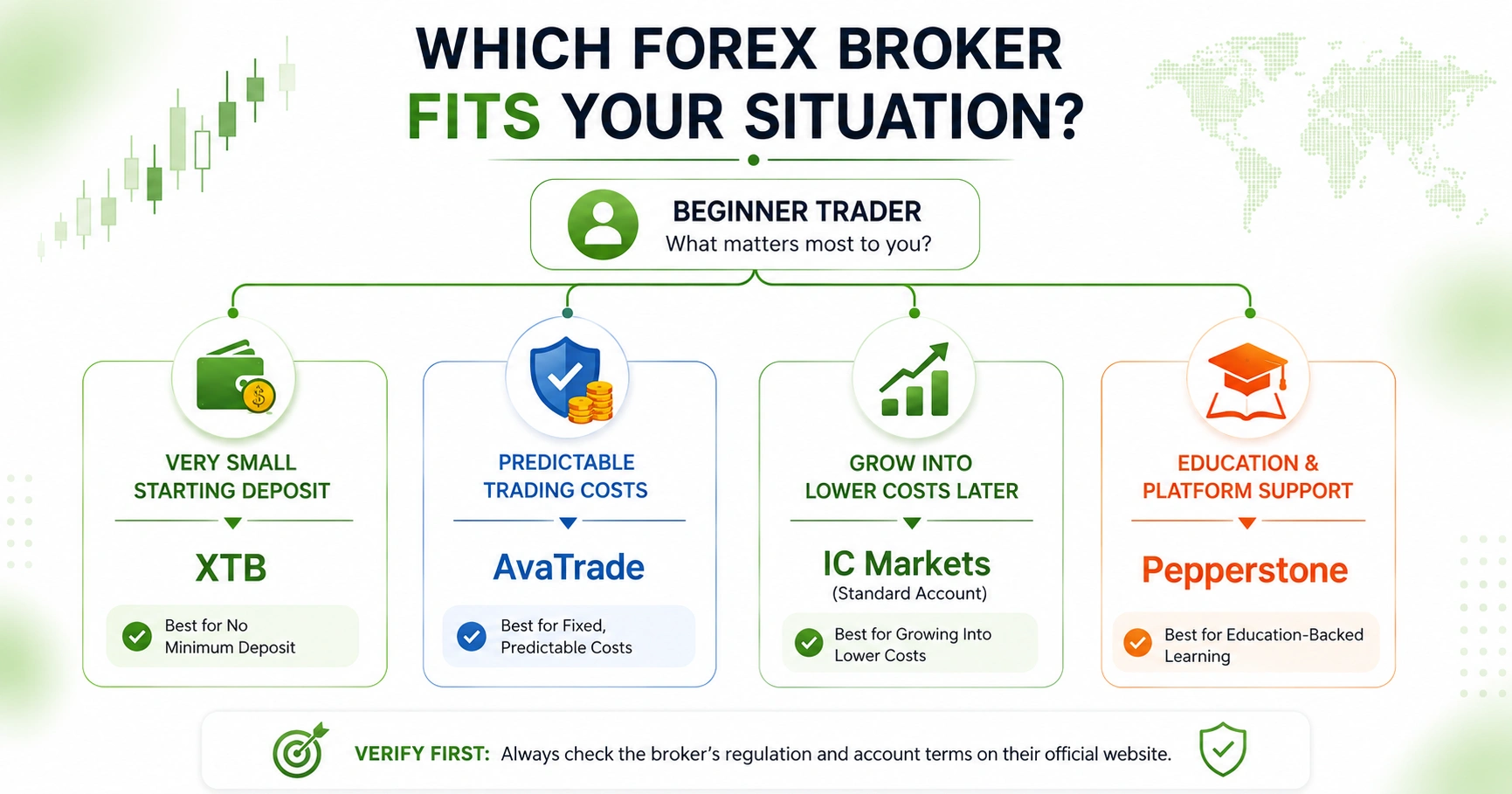
| Your Situation | Best-Fit Pick |
|---|---|
| Want to start with very little money | XTB ($0 minimum deposit) |
| Prefer predictable, fixed trading costs | AvaTrade (fixed spread, no commission) |
| Want room to grow into lower costs later without switching brokers | IC Markets (Standard now, Raw Spread later) |
| Want structured education alongside trading | Pepperstone |
| Plan to demo trade for an extended period before going live | XTB, IC Markets, or Pepperstone (all offer unlimited demo access) |
How to Verify These Picks Yourself
Do not take any comparison list, including this one, as a final decision without checking the current terms yourself. Visit the broker's official account page directly and confirm the current minimum deposit and spread figures, since these change periodically. Then search the broker's exact legal entity name on the relevant regulator's public register, such as the FCA Financial Services Register or ASIC Professional Registers, to confirm the regulatory claim applies to the specific entity you'd be opening an account with. Our full walkthrough on what " regulated broker " actually means covers this verification process in detail, including why the brand name and the legal entity are not always the same thing.
Common Beginner Mistakes When Choosing a Broker
- Choosing based on the highest advertised leverage rather than understanding what leverage you'd actually use safely
- Skipping the demo account entirely and going straight to a funded live account before learning the platform
- Assuming a low headline spread means low total cost, without checking for a separate commission or wider spreads during volatile hours
- Not confirming which specific account tier at a broker is being reviewed, since the same broker often has multiple tiers with different costs and features
- Trusting a regulation claim without checking the specific legal entity, since brand names can operate under different licenses in different regions
Conclusion
There is no single best forex broker for every beginner, but the decision becomes far clearer once you separate what actually matters, deposit size, demo access, pricing simplicity, and confirmed regulation, from what doesn't, brand recognition or bonus promotions. XTB suits a near-zero starting deposit, AvaTrade suits predictable fixed costs, IC Markets' Standard account suits someone who wants room to grow into lower-cost trading later, and Pepperstone suits a beginner who wants structured education alongside their first trades. Whichever you lean toward, verify the current terms and the specific regulated entity yourself before depositing any funds. You can compare additional regulated providers beyond this shortlist in our full forex broker directory.
Disclaimer This article is for informational and educational purposes only. It does not constitute financial or investment advice. Forex and CFD trading involves significant risk of loss and is not suitable for all investors. Always verify a broker's current terms and regulatory status directly before depositing funds.
 Your brand here